
Articles
October 28, 2026
1 min read

Yuri Pylypenko
CEO at OLSOM
Articles
28 October 2026
4 min read
Why MES adoption decides your ROI
A live MES can still deliver nothing if the shop floor works around it. Here’s how daily usage turns into payback within months.
In this article:
This article continues OLSOM’s “Road to Smart Manufacturing” series — a practical exploration of what truly determines MES success.
In the previous part, we followed an MES project from roadmap to go-live. By that point, most of the visible work is done: the roadmap is approved, processes are mapped, and the system is deployed.
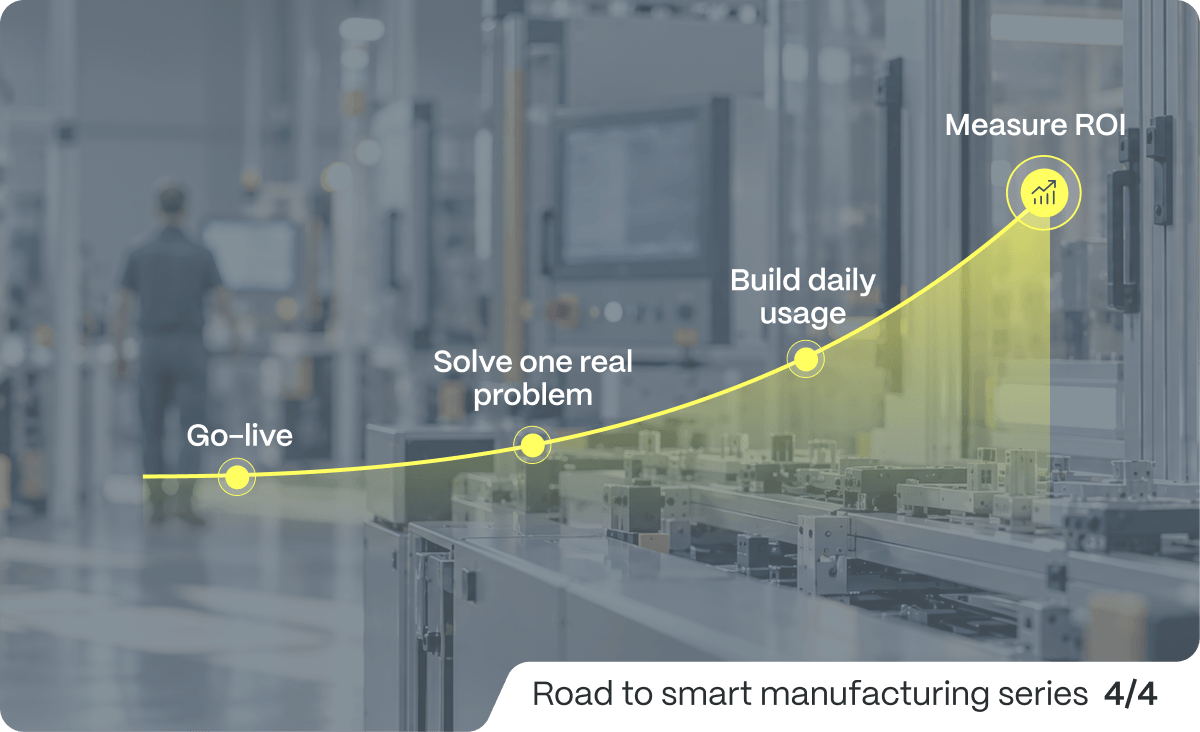
And yet, this is where many projects quietly stall. Go-live opens the phase that actually determines success: adoption.
As Yuri Pylypenko, CEO of OLSOM, puts it:
“You don’t get ROI from implementation. You get ROI from usage.”
In this article, we break down why adoption matters more than features, what drives real-world value in daily operations, and how manufacturers turn MES into measurable results.
Why MES adoption beats features
MES projects often start with feature comparisons, which is why earlier in this series we made the case for a value-driven MES approach. Once the system is live, features alone don’t create value. Usage does.
A system can be technically perfect and still never pay back. ROI fails to materialize when:
- operators bypass it
- engineers don’t trust the data
- managers don’t use it for decisions
This is why adoption is the real success factor.
“Features don’t deliver value on their own,” Yuri explains. “They only matter when people use them consistently in daily work.”
Start by solving one real problem
People don’t adopt systems because they’re told to. They adopt them because the system addresses real pain and fits their work.
This is where many MES implementations go wrong — they introduce capabilities, not solutions.
At OLSOM, adoption is built differently:
- Start with a clear operational problem
- Deliver a visible improvement quickly
- Expand from there
This creates what we call natural adoption — when people choose to use the system because it helps them.
Case Insight: When the Right Process Becomes the Easy One
At one Automotive Tier-1 supplier, operators found ways to bypass the process.
To avoid rework and improve individual KPIs, labeling was done outside the actual production flow. Everything looked correct on paper, but in reality, quality issues were reaching the OEM.
Visibility was never the issue. Process control was, along with a system that didn’t fit how work actually happened.
The OLSOM team implemented AGW, moving labeling directly into the process itself: triggered on demand and tracked across downstream operations through pack-out.
Instead of adding extra steps, the system made the correct process the easiest one to follow. Workarounds disappeared because they were no longer needed.
Result: reduction in quality claims and a successful OEM audit.
Systems that fit the role drive adoption
MES often fails for a simple, overlooked reason: the system doesn’t match how people work.
Operators, engineers, and managers interact with production in completely different ways, yet many systems treat them the same.
Operators: simplicity and clarity
- Step-by-step instructions
- Real-time validation
- Error-proofing workflows
The goal is not to “use an MES” — but to make the job easier and more reliable.
Engineers: control and flexibility
- Configure workflows without coding
- Adjust logic based on real production behavior
- Analyze process data
This reduces dependency on IT and speeds up improvements.
Managers: visibility and decision-making
- Real-time dashboards
- KPI tracking
- Cross-line and cross-site insights
This turns MES into a decision support system for the whole operation.
That’s why AGW, our smart manufacturing platform, is built as a no-code system: it adapts to each role instead of forcing everyone into the same interface.
Yuri sees this as the turning point: “Adoption is where MES either starts creating value — or stops completely.”
When each role gets what it needs in the context of its work, usage grows on its own. That is also where time-to-value shortens and the return starts to show.
Value comes from capabilities working together
Another key insight from Yuri: MES value rarely comes from a single feature. It comes from how capabilities work together.
Some capabilities create value mainly through their effect on other processes.Take quality as an example:
- Operator guidance prevents errors
- Traceability isolates defects
- SPC detects trends
- Validation blocks non-conformances
Individually, each helps, but together they transform the process.
Implementations often fall short when features are deployed in isolation instead of aligned to outcomes.
Case Insight: Connecting the Process to Reduce Quality Claims
Another Automotive Tier-1 supplier faced recurring quality issues, but the root cause wasn’t clear.
Sub-assembly stations and the main production line operated in separate systems, with no shared traceability. As a result, inconsistencies moved through production unnoticed and only surfaced as customer claims.
Once AGW was implemented, sub-assemblies were integrated into a single traceable flow. Issues became visible and could be stopped earlier.
Result: 7% fewer quality claims and strong OEM audit scores.
When MES becomes a business tool, not a data collector
On the shop floor, the gap between “system deployed” and “system delivering value” is easy to see. The data starts shaping how work gets done.
This is the point where MES becomes a business tool and its effect becomes measurable.
According to Yuri, the impact of MES should be reflected across three levels:
Operational performance
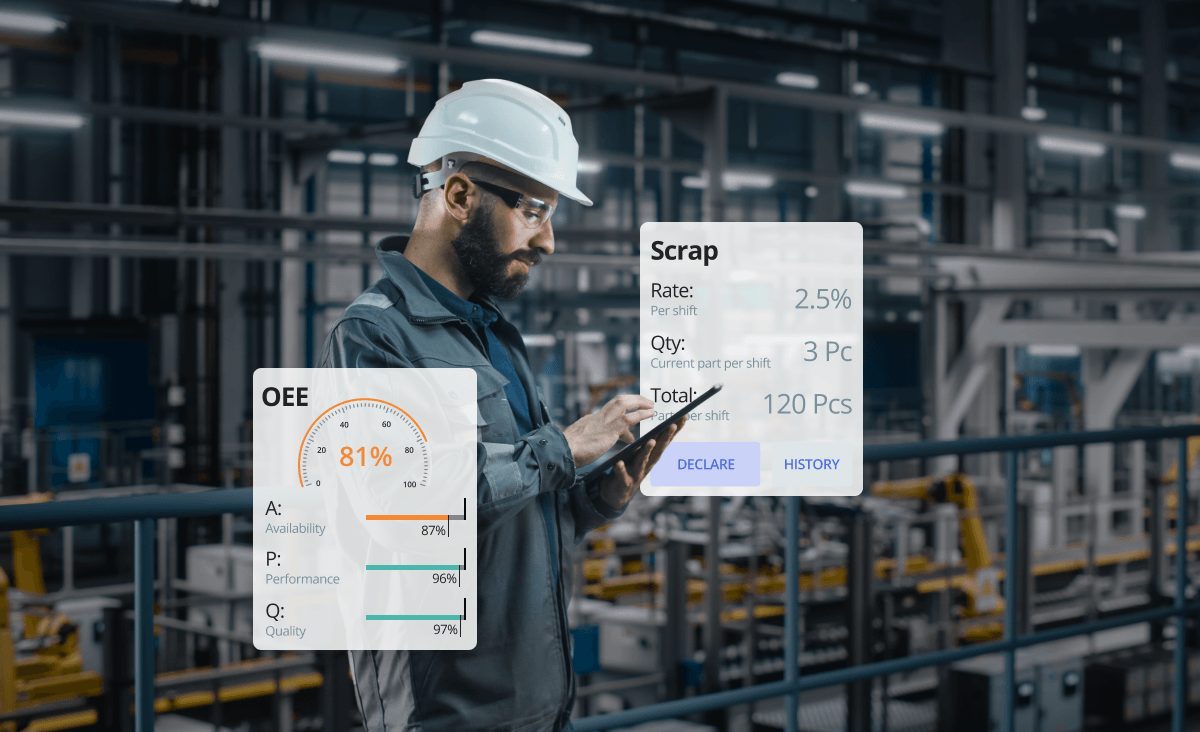
- OEE improvement
- reduction of production losses
- more stable cycle times
Quality
- scrap reduction
- higher first-pass yield
- fewer quality claims
Traceability & compliance
- faster containment in case of issues
- stronger audit performance
- complete, reliable production data
Each of these shows up in daily operations, long before the next board report.
How to measure MES adoption: the KPI most plants skip
The most common mistake is measuring MES ROI before measuring adoption. Without usage, the data stays incomplete and processes stay exactly as they were.
That’s why, in practice, the most important MES KPI is also the simplest:
- Are people actually using the system?
- Do they trust the data?
- Are decisions based on it?
Yuri’s test is blunt: “If the system isn’t used in daily work, it doesn’t exist operationally.”
How long until an MES delivers ROI?
Many manufacturers still assume an MES payback period is measured in years.
“If you solve the right problem first, you should see impact within months,” Yuri says.
Getting there means trading full-scale transformation for a narrower, faster path:
- starting where the losses are highest
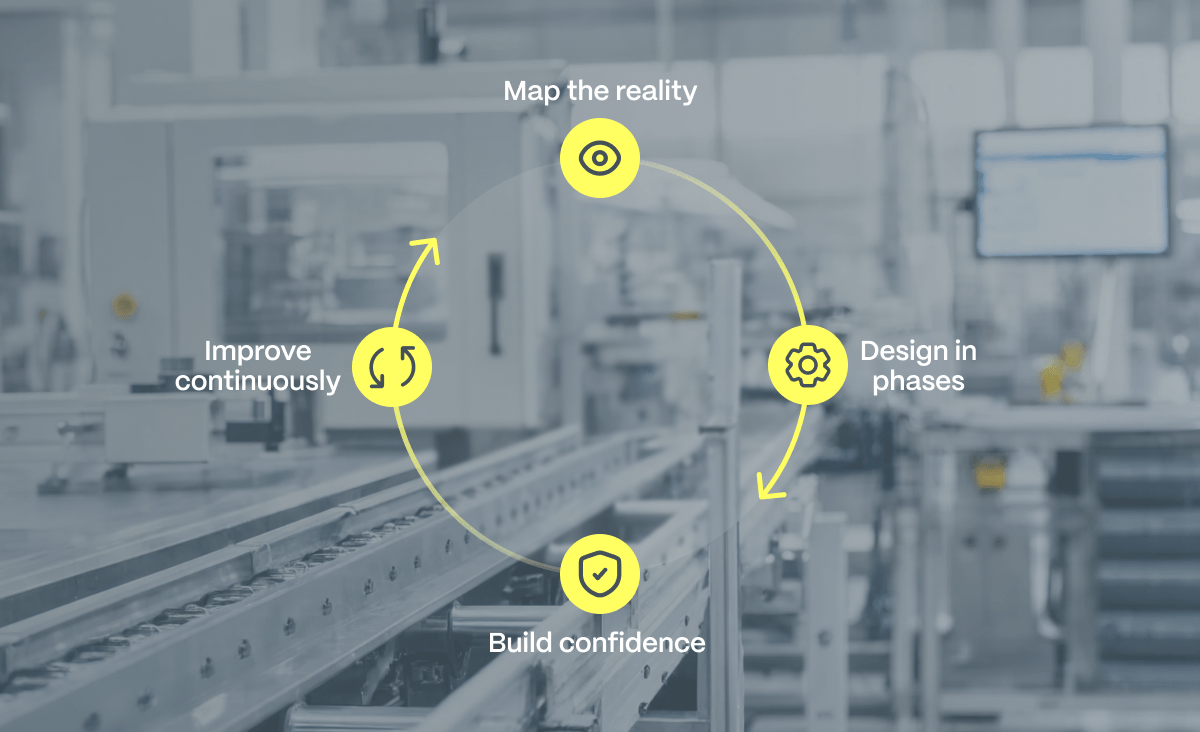
- rolling out in controlled phases
- building fast feedback loops
Value is not something that appears at the end of the project. It is built step by step, from the very first implementation decisions.
Usage Comes First. Results Follow.
Deployment is only the starting line for MES success. What counts is what happens after:
- whether people trust the system
- whether they use it daily
- whether it actually improves their work
Once those are in place, reliable data and measurable ROI come naturally.
MES doesn’t create value on its own. People create value — when the system helps them do their job better.
— Yuri Pylypenko, CEO of OLSOM
In the end, an MES proves itself by how consistently it becomes part of everyday operations.
MES ROI isn't guesswork, here's the pattern that predicts it.
Get the MES playbook—a 4-stage framework from planning to execution to make sure your next MES move actually pays off. Instant access.
Oops! Something went wrong while submitting the form.


Smart solutions that adapt to your unique operations

2026 @All Rights Reserved
Made by SNIG