
Articles
September 2, 2026
1 min read

Yuri Pylypenko
CEO at OLSOM

Max Liashenko
Head of Services
Articles
05 October 2026
4 min read
From roadmap to go-live: the anatomy of a successful MES implementation
The stage between roadmap approval and go-live decides whether MES delivers. Here's what makes rollouts predictable instead of disruptive.
In this article:
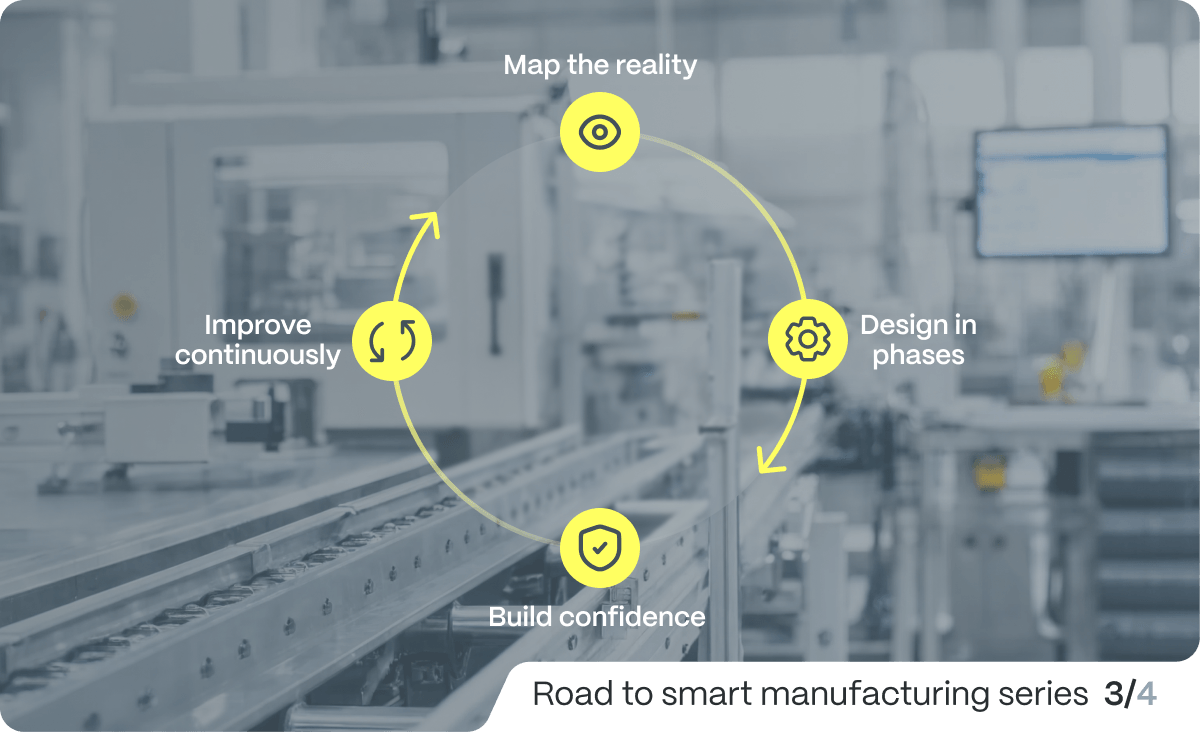
This article continues OLSOM’s “Road to Smart Manufacturing” series, exploring what truly determines MES success.
In previous articles, we examined why MES projects fail and how value-driven thinking delivers ROI. Yet even when expectations are aligned and ROI is agreed upon, one decisive phase remains: execution.
Between MES roadmap approval and go-live lies the most sensitive part of the journey — mapping, design, configuration, and adoption. It is here that operational assumptions are tested.
As Yuri Pylypenko, CEO of OLSOM, notes, “You only truly understand the factory once you start mapping it in detail.”
He's joined by Max Liashenko, Head of Services at OLSOM, who leads global MES implementations. Together, they outline what makes MES rollouts predictable—and what typically disrupts them.
Why Strong Strategies Still Fail During Execution
At the strategic level, MES initiatives often begin with clarity. Objectives are defined, KPIs are established, and stakeholders agree on expected improvements. But once implementation begins, another layer of complexity becomes visible.
“Execution is where assumptions meet operational reality,” Yuri explains. “The shop floor always has more nuance than the process description.”
From Max’s perspective, most MES implementation challenges are not caused by the system itself.
“In many cases, the software works exactly as designed,” he says. “The real issues appear when we uncover blind spots in the initial understanding of the process.”
Differences between shifts, informal sequencing rules, or manual corrections that were never documented tend to surface during configuration or testing. This is where execution becomes decisive — when assumptions are tested against daily operations.
Execution also exposes organizational challenges. Unclear ownership can delay decisions and reduce accountability, while weak communication between departments makes it harder to align priorities and keep implementation moving.
At that stage, the goal is not simply to launch the system, but to close those gaps before they turn into operational friction.
Projects often slow down when teams:
- Underestimate process variability
- Overlook informal routines
- Leave ownership and accountability unclear
- Expand scope mid-implementation
- Treat go-live as the finish line
Without discipline during execution, even strong strategies can gradually lose direction.
Mapping the Current State: From Documentation to Reality
When starting an MES project deployment, OLSOM begins with observation.
“The first priority is to understand how work actually flows,” Yuri says. “Not how it is described in documentation, but how it moves through the plant in real conditions.”
In practice, this means examining:
- How orders move between stations
- Where operators make decisions manually
- Where data is recorded — and where it isn’t
- What exceptions happen daily
Effective mapping also depends on involving the right people. Operators, supervisors, quality, maintenance, planning, and IT each provide insights that documentation alone cannot.
In one implementation, a plant believed its production routing was fully standardized. During mapping, however, the team discovered that operators regularly adjusted sequence order to compensate for material delays that were not reflected in the ERP logic. The system on paper was stable; the real workflow was adaptive.
“If we had digitized the formal process without observing reality,” Yuri notes, “the system would have created tension instead of clarity.”
It's also the right time to validate data quality. Inaccurate master data, duplicate materials, missing equipment definitions, or outdated routing information can quickly become implementation issues if left unresolved.
This is where configurability becomes important. With a no-code environment such as AGW, workflows and validations can be adjusted as insights emerge, without turning each refinement into a development project. It reduces the gap between discovery and implementation.
As Max points out, mapping is ultimately a risk-reduction phase. “The deeper the mapping, the fewer surprises later,” he says. “It’s much easier to adjust logic before go-live than after.”
The Human Factor in Production
Beyond technical mapping lies another layer: human behavior.
Yuri has repeatedly seen that operators develop routines that help maintain stability under real production pressure.
“People adapt to keep the line running,” he explains. “They create small habits that are rarely documented.”
These may include batching actions to save time, adjusting task order during high workloads, or applying informal checks based on experience. When they are overlooked, the MES workflow can feel restrictive rather than supportive.
Max points out that many rollout difficulties begin when teams underestimate the human factor.
“Go-live issues are often behavioral, not technical,” he says. “If the system doesn’t align with how people actually work, adoption slows down.”
Understanding human reality does not mean preserving inefficiencies. It means distinguishing between habits that support stability and habits that require structured change. Ultimately, user adoption determines implementation success. When people understand how the system supports their work, rather than simply monitoring it, they are much more likely to embrace change.
Designing a Phased Implementation
Once mapping is complete, the temptation to redesign everything at once is strong.
Teams often see manufacturing execution system implementation as an opportunity to standardize across sites, introduce additional KPIs, and eliminate legacy practices in a single phase. While the ambition is understandable, experience shows that expanding scope too quickly increases risk.
“A good implementation roadmap solves the biggest pains first,” Yuri says. “You don’t redesign the entire factory on day one.”
Max has seen that projects are far more predictable when they move in defined stages.
“The teams that work in clear phases experience fewer disruptions,” he explains. “Each phase has a specific objective and clear success criteria. Once measurable results are achieved and the phase is stable, the next capability is introduced.”
This phased approach reflects modular thinking in practice. With AGW, factories typically begin with the capability that addresses their most immediate operational challenge — whether that is traceability, operator guidance, or scheduling discipline — and expand progressively.
Building layer by layer allows the organization to absorb change without operational shock.
Preparing for Go-Live: Building Adoption Early
Technically, go-live is a date, but in practice it marks a transition.
“What matters most on day one is trust,” Yuri says. “If people do not trust the system, they will work around it.”
Preparation begins well before activation. It includes:
- Role-specific training
- Clear communication about why changes are being introduced and how the end users will benefit from them
- Early involvement of supervisors and team leaders
- Pre-cutover trials in controlled environments
Max highlights the importance of early exposure.
“When teams interact with the system during pilots or testing phases, go-live feels like a continuation,” he explains. “It does stress the team like something completely new.”
Communication plays a key role. When the system is introduced as a support tool that brings clarity and structure, rather than as a monitoring mechanism, resistance decreases and adoption becomes smoother. After go-live, teams should continue evaluating how the system is being used alongside data quality, production KPIs, and user feedback to support continuous improvement.
What Separates a Smooth MES Rollout from a Difficult One
In OLSOM’s experience across global MES implementations, stable rollouts are rarely accidental.
They tend to share a few consistent traits:
- Active business ownership
- Clear decision-making structure
- Disciplined scope control
- Close collaboration between plant teams and implementation partners
- Effective training and support
Max observes that the tone of collaboration often determines the outcome.
“When an MES implementation project is treated as a shared responsibility rather than a vendor task, alignment is stronger,” he says. “Problems are solved earlier.”
By contrast, difficult rollouts often involve shifting MES deployment requirements, unclear governance, or disengaged sponsors. In such environments, even well-configured systems struggle to gain traction.
Ultimately, successful execution depends on alignment — when strategy, operational reality, and organizational readiness move in the same direction.
Making Execution Predictable
MES implementation is not a single milestone. It is a structured transition from current practices to improved operational discipline.
Successful MES rollouts are built on thorough mapping, a clear understanding of how work actually happens, disciplined phasing, and alignment across strategy and operations.
Go-live should feel prepared, not dramatic.
— Yuri Pylypenko, CEO of OLSOM
When execution is approached with realism and collaboration, MES becomes a stable foundation for continuous improvement rather than a disruptive experiment.
MES ROI isn't guesswork, here's the pattern that predicts it.
Get the MES playbook—a 4-stage framework from planning to execution to make sure your next MES move actually pays off. Instant access.
Oops! Something went wrong while submitting the form.


.png)
Smart solutions that adapt to your unique operations

2026 @All Rights Reserved
Made by SNIG