
Articles
May 19, 2026
1 min read

Yuri Pylypenko
CEO at OLSOM
Articles
27 September 2026
4 min read
Why MES implementation projects fail — and how to avoid it
Why do MES projects stall? It's rarely the technology. It's expectations, ownership, and culture. Here's how to set yours up for success.
In this article:
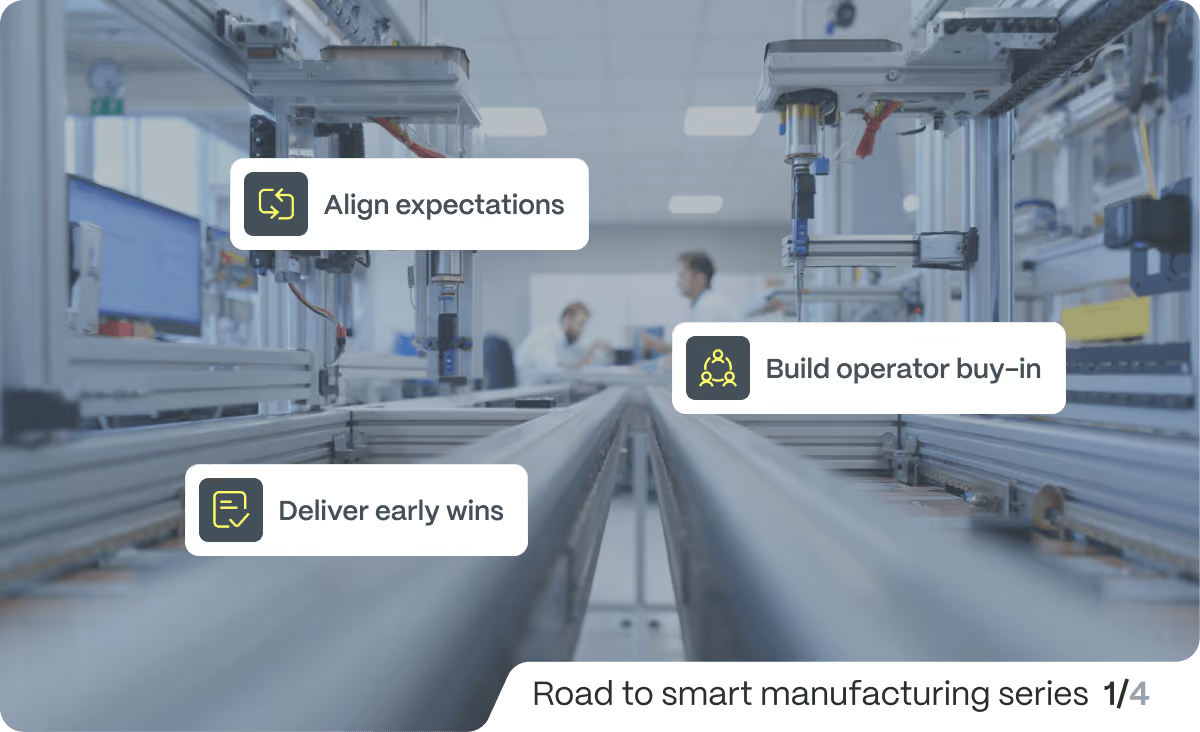
This article is part of OLSOM’s “Road to Smart Manufacturing” series — a practical guide to helping manufacturers build MES strategies that actually work.
Manufacturers today see the manufacturing execution system (MES) as the backbone of digital transformation. Yet too often, MES implementation projects end up delayed, underused, or even abandoned — not because of technology, but because of people, process, and planning.
Yuri Pylypenko, CEO of OLSOM, has seen both sides: implementations that deliver fast, measurable impact, and others that never reach their full potential. In this article, he shares what separates a successful MES project from a failed one, and what it really takes to lay the foundation for smart manufacturing from day one.
The Expectation Trap: Misaligned Scope and Requirements
The number one reason MES implementation projects fail is misaligned expectations between business, IT, and the vendor.
"A manufacturing execution system can mean different things to different people," Yuri explains. Production monitoring, quality tracking, scheduling, analytics. Without a shared definition of what the system should do, even the best software can miss its mark.
At one plant, Yuri recalls, the local team expected real-time operation-by-operation visibility, while corporate IT envisioned a limited end-of-line solution. Both were right in their own way, but the mismatch caused frustration and stalled results.
Before a single line of code is written, define the project scope, requirements, and success metrics. Align every stakeholder on the same purpose. Most MES implementation challenges trace back to this missing alignment at kickoff.
The The Missing Business Champion: No Internal Ownership
Even with the scope clearly defined, projects still stall when no one inside the customer organization owns the outcome. A successful MES implementation strategy depends on one thing above all: a business owner who drives the project from day one.
"At the end of the day, the end user of the system is the business", Yuri emphasizes.
Too often, MES projects are driven by IT, while production, logistics, or quality teams remain passive participants. Without a business champion who owns the project from the customer side, engagement drops, communication breaks down, and the solution fails to take root.
A strong internal sponsor bridges the gap between business needs and technical delivery. They keep expectations realistic and help the vendor deliver real value instead of assumptions. In practice, this is what good MES project management looks like from the customer side.
Culture Eats Technology: Resistance and Change Management
A business champion can secure resources and buy-in at the top, but the people who actually use the system every day decide whether it succeeds. MES adoption depends more on culture than on software. If the culture doesn't support innovation, the implementation will fail, even when the system works perfectly.
Yuri shares a story of operators who intentionally found ways to crash an MES station just to create downtime and take a break. The issue wasn't technical. It was cultural. When frontline operators see new systems as threats rather than tools, adoption suffers.
That's why change management in manufacturing matters as much as the software itself. Workforce transformation has to run in parallel with the technical rollout. This is also the reason OLSOM advocates for a phased, incremental rollout instead of a 'Big Bang' launch. It gives teams time to adapt, learn, and trust the new way of working. "Any MES implementation is a dramatic change," Yuri notes. "People need time to adjust."
From Failure to Success: A Phased MES Implementation Approach
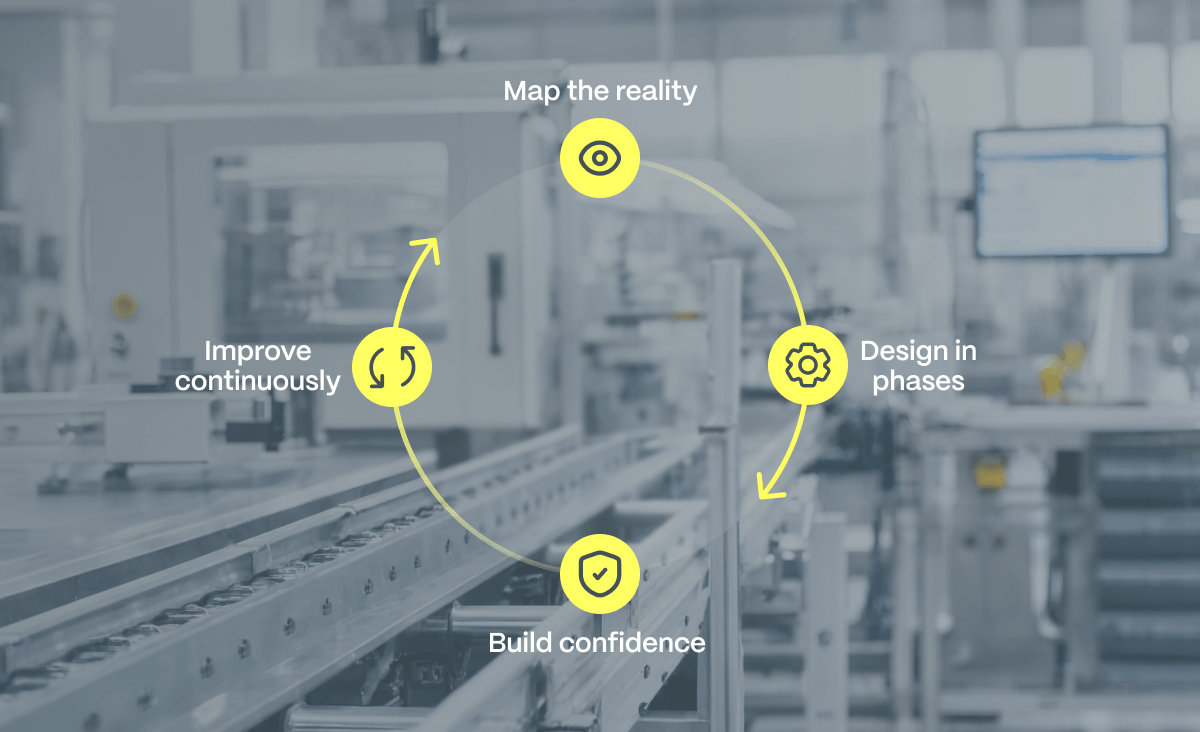
OLSOM helps manufacturers build a personalized MES implementation roadmap that delivers measurable value from day one rather than waiting months or years for ROI.
"We identify the biggest pains, whether it's planning, quality, or visibility, and address them first. Then we move step by step," Yuri explains.
This phased approach is what separates a smooth deployment from a stalled one. Each phase has clear goals, KPIs, and success criteria, allowing teams to learn, adapt, and expand the system with confidence. It also makes MES implementation ROI visible early, not buried in a multi-year business case.
Our job isn't to sell a system. It's to solve a real problem. When the first phase delivers value, everything else becomes easier
— Yuri Pylypenko, CEO of OLSOM
Laying the Strong Foundation for MES Implementation
Every MES implementation starts with clarity: aligning expectations, defining value, and preparing people for change. The technology itself rarely fails. What fails is communication, ownership, and culture.
So how do you avoid a failed MES project? Start with the people, not the platform. Define scope before kickoff, secure a business champion, invest in change management, and roll out in phases. With the right approach, even complex manufacturing environments can move toward Industry 4.0 one smart step at a time.
At OLSOM, we believe MES success isn't about a perfect launch. It's about building trust, learning continuously, and delivering value from the first phase onward. Start smart, and the rest will follow.
Read next in the series: From features to ROI. A value-driven MES approach
What makes an MES upgrade pay off in months, not years?
Get the MES playbook—a 4-stage framework from planning to execution to make sure your next MES move actually pays off. Instant access.
Oops! Something went wrong while submitting the form.


.png)
Smart solutions that adapt to your unique operations

2026 @All Rights Reserved
Made by SNIG