
Articles
June 12, 2026
1 min read

Olsom Team
Articles
02 September 2026
4 min read
5 takeaways for manufacturers from AI & Big Data Expo 2026
What leaders from Ford, Dow, Airbus, and Schneider Electric are saying about AI, digital transformation, and manufacturing in 2026.
.avif)
In this article:
Intro
AI & Big Data Expo 2026 was not short on ambition. Thousands of technology and business leaders packed San Jose on May 18–19 to talk AI, automation, and the factory of the future. But the most useful conversations were not about AI in theory. They were about why it stalls on the factory floor — and what actually moves it forward.
The OLSOM team attended as part of a business mission to the United States supported by the Center of Economic Initiatives of West Pomeranian Voivodeship. Over two days we moved between rooms, listened to speakers from Ford, Dow, Airbus, Schneider Electric, Rockwell Automation, Greif, and others — and kept noticing how often their answers overlapped.
Here are five takeaways that stood out.
1. The hard part was never the technology
Chris Bruman, Chief Data & Analytics Officer at Dow, said it plainly: the technology is fine. It keeps getting better. What isn't keeping up is everything around it.
"I say it's data and culture that are really the two big challenges for us to be successful."
Dow has committed $2 billion to enterprise transformation. But Bruman's point was that money and tools are not the constraint. Data quality is. Organizational alignment is. Getting people to trust the systems they're being asked to use is.
That last part surfaced in almost every room we walked into. Kevin Clark, VP of Industrial Strategy at Brightly (Siemens), spent ten years on the plant floor before moving into technology strategy. His perspective was harder to argue with than most:
We very easily talk about people not being needed in a particular task. To you and I, that's awesome — it's a return on investment. To people on the plant floor, it's: what do I do now?
Prosci research adds weight to this: 46% of employees are currently involved in at least three major transformation initiatives simultaneously. Change fatigue is real, and it is one of the primary reasons projects stall before they deliver anything.
The implication for manufacturers is straightforward. AI adoption in manufacturing depends on more than picking the right platform. Without clean data, a clear adoption plan, and leadership that stays engaged, even the right platform will underperform.
We explored this dynamic in more detail in our recent article: Why MES implementation projects fail — and how to avoid it
2. A dashboard is not a strategy
Most manufacturers have sensors. Most have dashboards. The promise of IIoT in manufacturing was that this data would change how decisions get made. Most are still waiting.
The teams seeing real results are the ones who stopped treating connectivity as the finish line:
"Where I've seen most project success is where customers stop treating IoT as just a monitoring project — and start closing the loop between the sensors, controllers, and machines, and actually acting upon the data."— Sharad Bhatam, Rockwell Automation
At Schneider Electric, that loop is already paying off. Connecting energy management systems across facilities, and giving teams the visibility to act on what they see, has been delivering 10% savings on energy bills. Helena Gillibert shared the example not as a technology win but as a workflow one — the savings came from people acting on data, not from better sensors.
Ford is on the same path at a much larger scale. Apurva, who leads applications and data across all Ford plants worldwide, described the shift from deploying individual data sources to building a single platform that can actually inform decisions in real time.
The value of a connected factory is not in the data itself. It is in whether the data reaches the right person at the right moment with enough context to act.
3. Start with the problem, not the platform
This one came up so many times across different panels that it started to feel less like advice and more like a confession. A speaker on the digital twins panel described it with the kind of specificity that only comes from having lived it:
"One of the worst things for us is when someone comes to us and says, 'We need to buy a digital twin.' And you go — why? 'Because the CIO mandated us.' But what are you going to do with it? 'No, we don't know yet, but we need to buy one of those things.' That is the worst case to try and start a digital twin project."
The same pattern showed up on the agentic AI panel. Joseph Rose from JBS Dev had the most refreshingly pragmatic take of the two days:
"You don't have to boil the ocean. Go into your BI stack where you have an ETL job, add in one HTTP call to an LLM, take that result and do something with it — and then you've implemented an agentic workload without having to pay anyone else all of their crazy licensing fees."
Starting small is not about thinking small. It is about proving value fast enough to build the trust required for anything bigger. Quick wins that connect to a broader strategy compound. Quick wins that don't, fragment.
4. People are your real competitive edge
Sarah Clark has an interesting way of thinking about what AI actually threatens.
Clark is VP of Strategic Business Transformation at Greif, an industrial manufacturer across 40 countries and 250 facilities. Her argument was not that AI is dangerous. It was that AI is equalizing — and that changes what competition looks like.
All of a sudden, our competition can start to address some of these things that we once felt like was our competitive advantage. And so what we're here to talk about today is that people are really that differentiation.
She cited McKinsey data on AI workforce adoption: 76% of the workforce is now using AI at some level, up from 30% in 2023. Her analogy was blunt — if 25% of your workforce refused to use a computer, the business wouldn't function. AI is at the same inflection point.
Her framework for thinking through this was the most practical thing we heard on the topic: categorize every type of work into what you automate, accelerate, augment, and protect. That last category is worth sitting with. The relationships, the judgment calls, the trust built over years with customers and teams — those are not things to hand to a machine. They are the point.
5. Build vs. buy is no longer a binary decision
The closing panel had a simple question on the agenda: should you build your AI capabilities or buy them? The honest answer was — it depends, and probably both.
Some large enterprises have already burned through their entire annual AI token budget in a single quarter — a number Sanjay Pasari from UPS shared to make a point that the cost of AI governance in manufacturing is not theoretical.
Rina Solomon, who leads AI partnerships at Airbus, came at it from a different angle. In regulated industries, the question is not just cost — it is control. Proprietary data, compliance requirements, and audit trails make handing everything to an external vendor a risk in itself.
The trap most companies fall into is somewhere in between:
"What concerns me the most when I hear about 'we're going to build AI' is when it's standalone AI, disconnected from how the business actually operates." — Sandra Temperink, SAP
Build or buy matters less than whether it fits. For manufacturers, the real questions are: how well does it connect to existing systems, how much control do you keep over your data, and what does the total cost look like two years from now — not at the point of purchase.
What we took away
None of the five themes we heard at this event were new to us. We have heard versions of them from manufacturers we work with, in different languages, across different industries. What struck us in San Jose was how consistent they were — across company sizes, geographies, and levels of digital maturity.
The companies furthest along were not the ones with the most advanced technology. They were the ones who had figured out how to make change stick. Clean data, clear adoption strategies, problems defined before platforms selected.
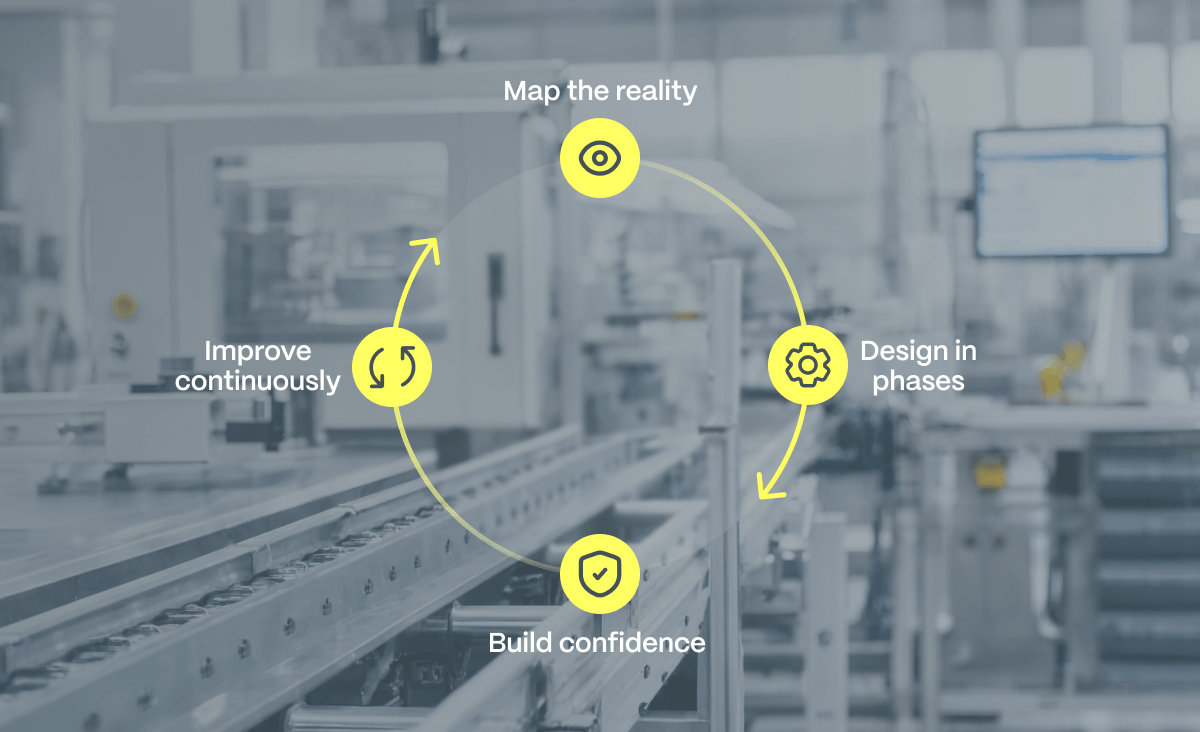
It is the same philosophy behind AGW, our smart manufacturing platform: fit into how a plant already works, deliver something measurable early, and earn the next step. It is good, occasionally, to sit in the same room as the people shaping the industry and hear the conversation land exactly where you expected it to.
About this event
Zoia Petrochenko and Alexander Gats represented OLSOM at AI & Big Data Expo North America on May 18–19, 2026, as part of a business mission supported by Centrum Inicjatyw Gospodarczych of the West Pomeranian Voivodeship.
The economic mission to the United States for AI & Big Data Expo North America 2026 is implemented within the framework of the non-competitive project "Ster na eksport", carried out under the European Funds for Western Pomerania 2021–2027 Program, Action 1.9 Preparation and implementation of new business models for enterprises (including joint projects of enterprises and business support institutions), Project Type 3 Export promotion and internationalization of SMEs, implemented by the Center of Economic Initiatives of the Marshal's Office of the West Pomeranian Voivodeship (CIG).
.png)
Smart solutions that adapt to your unique operations

2026 @All Rights Reserved
Made by SNIG